
Fairytale wedding dress styles rely on volume, soft light-catching texture, and construction that still lets a bride sit, dance, and move through a long day. Most readers searching this look want a gown that photographs well in a formal or garden setting without becoming heavy or costume-like. The list below groups options by silhouette, neckline and sleeve treatment, surface detail, and practical adaptations so fabric weight, support, and train length can be matched to venue, season, and comfort. Most bridal gowns are made to order with multi-month lead times; alterations are a separate cost that usually require several fittings. Approximate price ranges appear only where they help set expectations and vary by designer, fabric, region, and work done after the gown arrives.
Silhouettes for Volume and Shape
1. Layered Tulle Ball Gown
A fitted bodice meets a wide, multi-layer tulle skirt that flares from the natural waist and fills an aisle or doorway. The airy netting creates the floating movement many associate with storybook gowns while remaining lighter than dense satin. Fine layers can be ordered with or without a slight sheen so the skirt catches light without looking metallic. This construction works best when the waist seam sits exactly at the natural waist; a dropped seam makes the volume feel heavier. Many salons stock sample sizes that can be ordered in the preferred layer count.
- Aisle presence: The full skirt reads clearly from a distance in ballrooms, estates, or large garden settings.
- Heat and movement: Lightweight tulle stays cooler than dense fabrics but can catch on outdoor surfaces; a secure bustle is essential once the ceremony ends.
- Fitting-room check: Sit and walk in the sample to confirm the waist stays put and the skirt does not collapse or drag.
2. Structured Mikado Ball Gown
Mikado is a crisp, medium-weight fabric that holds a full skirt shape with fewer layers than tulle, giving clean lines and a quiet sheen. The bodice is usually boned for support, and the skirt stands away from the body rather than floating. This version suits cooler venues or indoor ballrooms where a more architectural silhouette is wanted. Because the fabric has body, it resists wrinkling better than soft tulle during travel or long portrait sessions. Ordering early allows time for the precise waist placement that keeps the volume balanced.
- Venue match: Strong in formal indoor spaces or cooler evening ceremonies where structured drape looks intentional.
- Fabric behavior: Holds folds without constant steaming; less airy than pure tulle, so confirm comfort in warm conditions.
- Tailoring note: Hemming and bustling are straightforward once the length is set; most gowns fall in the mid-to-upper price range before alterations.
3. Soft A-Line Lace Fairytale Gown
An A-line skirt falls gently from the waist without the extreme width of a ball gown, while lace appliqué or an overlay supplies the romantic texture. The silhouette is easier to navigate in tighter aisles, on grass, or through doorways yet still reads as storybook when the lace is floral or botanical. Crepe or soft satin under the lace keeps the shape smooth. This option appeals when full volume feels impractical but the desire for delicate surface detail remains. Sample sales sometimes include this hybrid style at lower cost.
- Practical settings: Garden ceremonies, historic homes, or any venue with limited floor space.
- Wearability trade-off: Easier sitting and dancing than extreme ball-gown volume; lace can snag if not carefully handled.
- Budget note: Often available off-the-rack or as a sample, reducing lead time compared with fully custom orders.
Necklines and Sleeves for Romance
4. Off-the-Shoulder Neckline with Soft Drape
The neckline sits just below the collarbone with sleeves or fabric that rest lightly on the upper arms, framing the shoulders without straps. Soft tulle or organza draping keeps the look light rather than rigid. Many versions include hidden boning or a built-in band so the neckline stays in place through movement. The style pairs well with full skirts or A-line shapes and photographs cleanly from the front and three-quarter angles. Confirm the sleeve placement during the fitting so the fabric does not slip or dig.
- Photo strength: Highlights the collarbone and upper chest while balancing a voluminous skirt.
- Support test: Raise both arms and lean forward in the fitting to check that the neckline stays secure without a separate bra.
- Season fit: Comfortable in moderate temperatures; add a light wrap if the ceremony is outdoors after dusk.
5. Illusion Neckline over a Sweetheart Bodice
A sheer illusion panel covers a classic sweetheart neckline, creating a higher, more modest line while the structured cups underneath provide shape. Lace appliqué often continues across the illusion for continuity. The construction gives the appearance of coverage without the weight of opaque fabric at the neck. It works across many silhouettes and is frequently chosen when a strapless or low neckline is desired but full coverage is preferred for the ceremony. The illusion can be ordered in skin-tone or white mesh.
- Modesty balance: Provides visual coverage while retaining the curved sweetheart shape underneath.
- Undergarment note: Built-in cups or a strapless bra usually suffice; bring the intended undergarments to the fitting.
- Alteration ease: The sheer panel is typically sewn in place, so neckline adjustments are limited once ordered.
6. Long Lace Sleeve Fairytale Dress
Delicate lace sleeves extend to the wrist or just past it, adding texture and coverage without bulk. The sleeves can be fully lined, partially lined, or left sheer depending on climate and preference. Floral or botanical lace continues the romantic theme from bodice to arms. This detail suits cooler weather, indoor ceremonies, or brides who prefer more coverage while still wanting a full or A-line skirt. Because lace stretches differently from the bodice fabric, precise fitting at the elbow and wrist is important.
- Coverage preference: Useful for cooler seasons or when long sleeves are wanted without heavy fabric.
- Movement check: Bend the elbows and raise the arms in the fitting to ensure the lace does not pull or gap.
- Season suitability: Breathable when the lace is open-weave; pair with a lightweight lining if the venue is warm.
7. Puff or Bishop Sleeve Detail
Soft volume at the shoulder or upper arm creates a storybook silhouette that echoes historic or whimsical illustrations. The sleeves are often made of tulle or organza so they remain light, and they can be detachable on some designs. This detail draws the eye upward and balances a full skirt. It works best when the sleeve circumference is proportional to the wearer’s frame so the volume does not overwhelm. Many versions include a narrow band or elastic at the wrist for control.
- Whimsical accent: Adds height and softness without changing the main silhouette.
- Practical limit: Can feel warm or catch on jewelry; test with the planned earrings and hairstyle.
- Detachable option: Some makers offer removable sleeves so the gown can transition after the ceremony.
Surface Details and Embellishment
8. Floral Appliqué Overlay
Individual lace or fabric flowers are applied by hand or machine across the bodice, waist, or skirt, creating raised texture that catches light. The appliqués can be sparse for subtlety or denser for a more ornate look. They sit best on tulle or organza bases so the flowers appear to float. This technique adds dimension without the weight of all-over beading. Care is needed during alterations because cutting through an appliqué can disrupt the design.
- Texture choice: Provides three-dimensional interest that reads clearly in photographs.
- Care reminder: Appliqués can snag; ask the salon about steaming and handling instructions.
- Customization path: Density and placement can often be adjusted on made-to-order gowns.
9. Beaded or Crystal Embellished Bodice
Small beads, sequins, or crystals are sewn onto the bodice or along the neckline, creating controlled sparkle that moves with the wearer. The embellishment is usually concentrated on the upper body so the skirt remains lighter. Quality varies; denser work raises both cost and weight. This detail suits evening or indoor ceremonies where light will catch the surface. Most salons recommend professional cleaning only after the wedding because home methods can loosen beads.
- Light play: Sparkle is most visible under indoor lighting or during golden-hour portraits.
- Weight consideration: Heavier beading increases gown weight; confirm comfort during a long fitting.
- Price indicator: Intricate beadwork typically places the gown in a higher tier before alterations.
10. Corset-Style Bodice with Boning
Vertical or spiral boning inside the bodice shapes the waist and supports the bust without a separate corset. The structure can be covered or partially exposed at the back. This construction holds the full skirt of a ball gown or A-line and reduces the need for heavy shapewear. Lacing at the back allows minor size adjustment on the day. Because the boning is sewn in, major size changes after ordering are limited.
- Support benefit: Defines the waist and holds the bust so the skirt hangs correctly.
- Fitting sequence: Multiple fittings are common so the boning channels sit comfortably.
- Day-of flexibility: Back lacing usually permits a small size change if needed.
11. Three-Dimensional Floral or Embroidery Details
Raised flowers, leaves, or embroidered motifs are applied so they stand slightly away from the fabric, adding depth beyond flat lace. The technique appears on bodices, hems, or scattered across the skirt. It reads as handcrafted and works on both full and A-line silhouettes. The added dimension can catch light and create soft shadows in photographs. Because the elements are dimensional, they require careful packing and steaming.
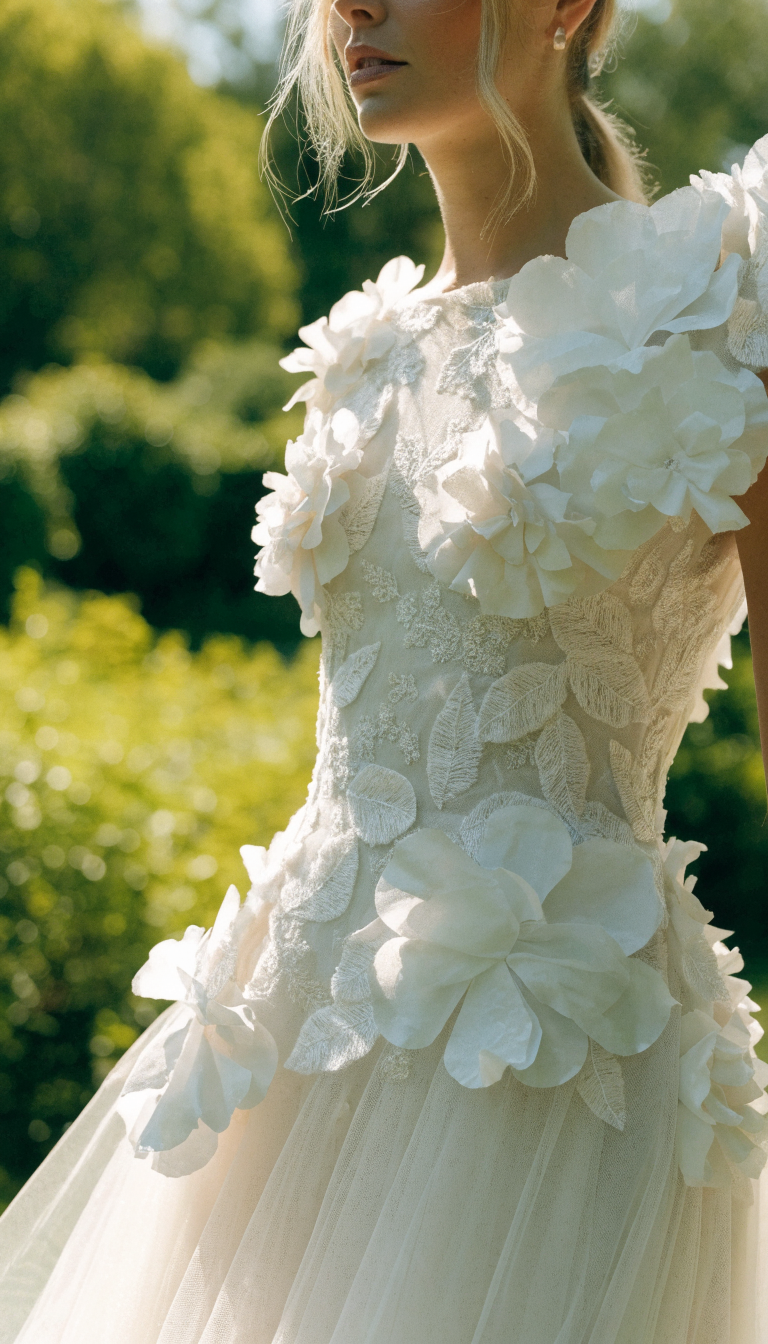
- Visual depth: Creates shadows and highlights that flat fabric cannot achieve.
- Handling note: Dimensional pieces can crush; request packing advice from the salon.
- Venue pairing: Especially effective in outdoor or garden settings where natural light emphasizes texture.
Trains, Backs, and Transition Options
12. Cathedral-Length Train
A train that extends several feet beyond the hem creates a long, continuous line down the aisle. The fabric is usually tulle, organza, or lace so the train remains manageable. A bustle is required after the ceremony so the wearer can move freely during dinner and dancing. Cathedral length suits large venues with open aisles; shorter chapel or sweep trains are easier in tighter spaces. Most gowns include a bustle point that is set during alterations.
- Aisle impact: Produces a clear visual line in photographs from the back.
- Bustle necessity: Practice the bustle method during the final fitting so it can be done quickly.
- Venue size: Best reserved for spaces with room to spread the train without obstruction.
13. Detachable Cape or Overskirt
A separate cape, capelet, or overskirt attaches at the shoulders or waist and can be removed after the ceremony. The piece is often made of matching tulle or lace so it coordinates with the gown. This option adds drama for the processional while allowing a lighter silhouette for the reception. Attachment methods vary from hooks to buttons; test the security during the fitting. The extra piece is ordered with the gown so fabric and color match.
- Transition ease: Removes the heaviest visual element once formal photos are finished.
- Attachment check: Confirm the fasteners hold during movement and do not mark the main gown.
- Versatility: Useful when the ceremony and reception have different formality levels.
14. Open or Corset Back
An open back or corset lacing reveals the upper back while still providing structure through the bodice. Buttons, lacing, or a combination of both can be used. The design photographs well from behind and pairs with long trains or veils. Comfort depends on how the lacing is finished and whether the edges are soft. Bring the intended undergarments so the back line can be checked for gaps or rolling.
- Back detail: Creates a focal point in processional and portrait shots.
- Undergarment match: A low-back bra or built-in support is usually required.
- Lacing practice: Have a second person practice the lacing method before the wedding day.
Practical Adaptations
15. Lightweight Chiffon or Organza Skirt
Chiffon or organza layers replace heavier tulle, producing soft movement with less volume and weight. The fabrics drape fluidly and feel cooler against the skin in warm weather. They can be layered over a smoother base so the skirt still holds a gentle shape. This choice suits outdoor or destination ceremonies where extreme fullness would be difficult. Because these fabrics wrinkle more easily, steaming before the ceremony is recommended.
- Climate fit: More comfortable in heat or humidity than dense multi-layer tulle.
- Wrinkle tendency: Pack carefully and plan for steaming on arrival.
- Movement quality: Flows rather than stands, which some wearers prefer for dancing.
16. High-Neck or Modest Lace Version
A higher neckline—often finished in lace—provides coverage while the rest of the gown retains full or A-line volume and soft detailing. The neck can be opaque or illusion, and sleeves are frequently long or three-quarter. This construction meets modesty preferences without abandoning the romantic silhouette. Support still comes from the bodice, so the higher neck does not need to carry the weight of the skirt. Many makers offer this as a customization on existing styles.
- Coverage preference: Useful when more neck and shoulder coverage is wanted.
- Proportion note: The higher neck balances a full skirt so the silhouette remains cohesive.
- Customization path: Often available as an alteration or special-order variation.
17. Fit-and-Flare with Dramatic Train
The bodice and hips are fitted, then the skirt flares below the knee or at mid-calf into a train. Lace, beading, or a soft tulle overlay supplies the fairytale texture without full ball-gown width. The shape is easier to walk and sit in while still offering a long line from the back. A bustle remains necessary for the train. This silhouette suits wearers who want definition through the body and drama only at the hem.
- Mobility advantage: Narrower through the hips than a ball gown, simplifying movement and car entry.
- Train management: Still requires a bustle; confirm the flare begins low enough for comfortable sitting.
- Photo balance: Creates a strong vertical line that photographs cleanly from the side and back.
18. Supportive Structure for Plus-Size Wear
A well-boned bodice, properly placed waist seam, and fabrics that move rather than cling allow the full or A-line silhouette to hold its shape at any size. Off-the-shoulder or lace-sleeve options remain available when the structure is sound. The key is internal support so the skirt hangs from the waist rather than pulling downward. Many designers now offer extended sizing with the same construction details used in smaller sizes. Bring a support garment that matches the intended day-of look to the fitting.
- Construction priority: Boning and a secure waist seam keep the volume balanced.
- Fabric choice: Medium-weight options that hold shape without stiffness tend to perform best.
- Fitting focus: Check that the skirt clears the floor evenly and the bodice stays smooth when seated.
19. Sample Sale or Off-the-Rack Fairytale Option
Sample gowns and off-the-rack styles often include the same tulle, lace, and silhouette elements at a lower price and shorter timeline. The size is fixed, so alterations become the main cost and timeline factor. This route works when the wedding date is closer than typical made-to-order lead times allow. Quality varies by how the sample has been handled, so inspect seams, beading, and fabric condition carefully. Many salons discount samples significantly once a style is discontinued.
- Timeline benefit: Available immediately or within weeks rather than months.
- Condition check: Examine for wear, loose beads, or stretched seams before purchasing.
- Alteration reality: Hemming, bustling, and any size adjustments still require time and additional cost.
A quick comparison of the most common silhouettes helps narrow choices before the first salon visit.
| Silhouette | Best Venue Fit | Heat Comfort | Alteration Complexity |
|---|---|---|---|
| Full Tulle Ball Gown | Large indoor or estate | Moderate (light layers) | Bustle and hem |
| Mikado Ball Gown | Formal indoor | Cooler preferred | Straightforward hem |
| A-Line Lace | Garden or tighter space | Good | Moderate |
| Fit-and-Flare + Train | Most venues | Good | Bustle required |
Bring three or four photos that show the exact neckline, sleeve, and skirt volume you prefer, plus the shoes and undergarments planned for the day. Start the search several months ahead so made-to-order timelines and multiple fittings can be completed without pressure. Once a short list exists, test sitting, walking, and the bustle method in the actual gown before the final payment.
How far in advance should a fairytale wedding dress be ordered? Most made-to-order gowns require several months from order to arrival, plus additional weeks for alterations. Starting six to nine months before the wedding is a common practical window, though sample or off-the-rack options can shorten that timeline.
Are sample-sale gowns a reliable choice for this style? Yes, when the sample is in good condition and the size is close enough that alterations remain reasonable. Inspect for stretched lace, loose beading, or fabric wear, and confirm the salon’s return or alteration policy before buying.
How many fittings are typical? Two to four fittings are common. The first sets the overall length and bustle points; later visits refine the hem, any neckline adjustments, and the final bustle method.
Can a full ball-gown silhouette be comfortable for dancing? It can, once a secure bustle is in place and the waist seam sits correctly. Lightweight tulle versions move more freely than dense structured fabrics; testing the bustled gown on a dance floor or open space during the final fitting is the clearest check.